


100 Mbps Vs 200 Mbps Vs 300 Mbps: Which Internet Speed Is Right For Your Home?
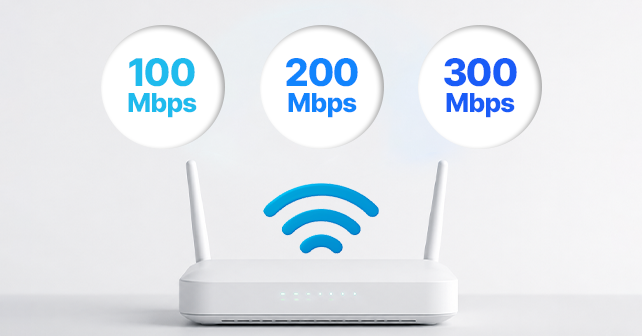
100 Mbps Vs 200 Mbps Vs 300 Mbps: Which Internet Speed Is Right For Your Home?
Choosing a WiFi plan can be confusing, especially when the only feature seems to be the speed. Is 100 Mbps sufficient, or do you really need to jump to 200 Mbps or even 300 Mbps? The answer has little to do with the number itself and more to do with how many people use the internet, the number of connected devices, and what your daily online activities consist of.
In this guide, we will compare 100 Mbps, 200 Mbps, and 300 Mbps to show what kind of home household usage scenario each provides.
This will help you select a broadband plan without paying extra for what you don't need. A 100 Mbps plan can work for 1-3 users, daily browsing, HD streaming, and video calls. A 200 Mbps plan is better for families with several simultaneous users and 4K streaming. If you want a WiFi connection for multiple 4K streams simultaneously or run online gaming consistently, then 300 Mbps would work best.
Which Internet Speed Should You Choose?
| Internet Speed | Best For | Typical Household |
|---|---|---|
| 100 Mbps | Everyday internet use, HD streaming, work-from-home users | 1-3 users |
| 200 Mbpss | Families with multiple devices, 4K streaming, hybrid work | 3-5 users |
| 300 Mbps | Gaming, smart homes, multiple 4K streams, power users | 5+ users |
Quick recommendation: If you’re not sure, a 200 Mbps plan is the best thing to choose and is suitable for most households.
How to Choose the Right Internet Speed?
When choosing a plan, it's recommended to ask yourself, "How does my family actually use the internet?" Your ideal broadband plan will depend on many factors, including the number of users, total connected devices, and whether activities like video calls and online gaming will be done at the same time.
Is 100 Mbps Enough for Your Home?
A 100 Mbps broadband plan is a good fit for households with light to moderate usage. This type of plan supports typical online activities like browsing the web, sending and receiving emails, using social media, making online purchases, streaming HD videos, and occasional video calls. If you live with just one other person and your devices are primarily used for these common tasks, 100 Mbps should be more than enough. This is an ideal choice for 1-3 users who do not have a whole host of smart devices connecting.
Choose 100 Mbps if you:
- Live alone or with one other person.
- Primarily use the internet for browsing, online shopping, and social media.
- Watch HD content on one or two screens.
- Occasionally work from home.
- Have approximately 5-8 connected devices.
Best suited for: Individuals, couples, students, and small households.
When Should You Upgrade to 200 Mbps?
For homes with multiple internet users, 200 Mbps offers a noticeable jump in performance. Your experience will be noticeably smoother, specifically when streaming content in 4K, participating in regular video meetings, engaging in online learning, and connecting more than just 2-3 devices without any slowdown during peak hours. For most growing families, this plan is the sweet spot between speed, reliability & affordability.
Choose 200 Mbps if you:
- Have 3-5 family members.
- Have multiple devices in use at the same time.
- Stream movies and shows in 4K.
- Participate in frequent video meetings while others use the internet.
- Want to avoid sluggishness during evenings.
Best suited for: Families, hybrid workers, and homes with multiple connected devices.
Who Should Choose 300 Mbps?
A 300 Mbps broadband plan is built for households with constant, high-demand usage. If you have several members streaming in 4K simultaneously, downloading large files, playing online games, and running various smart-home devices, you will benefit from the extra bandwidth. This plan is built for both performance and for adding capacity so that everything stays smooth, even when everybody is online.
Choose 300 Mbps if you:
- Have 5 or more people connected to the internet.
- Are a competitive online gamer.
- Frequently stream on multiple smart TVs.
- Use smart-home technology and CCTV cameras.
- Regularly download or upload large files.
- Want excess capacity to accommodate future needs.
Best suited for: Large families, gamers, content creators, and smart homes.
Compare Internet Speeds by Use Case
| Your Requirement | Recommended Speed |
|---|---|
| Everyday browsing & social media | 100 Mbps |
| HD streaming | 100 Mbps |
| Family with multiple devices | 200 Mbps |
| 4K streaming on multiple screens | 200 Mbps |
| Work from home + online learning | 200 Mbps |
| Competitive gaming | 300 Mbps |
| Smart home with CCTV | 300 Mbps |
| Large households | 300 Mbps |
Which Speed Is Best for Your Home Size?
While a bigger home does not automatically mean you need a bigger internet plan, the number of residents or devices connected scales with home size. Larger households with more simultaneously active connections usually benefit from more bandwidth.
| Home Type | Recommended Speed |
|---|---|
| 1BHK Apartment | 100 Mbps |
| 2BHK Flat | 200 Mbps |
| 3BHK Home | 200-300 Mbps |
| Villa / Independent House | 300 Mbps |
If you’re experiencing poor Wi-Fi signal in certain parts of your home, it may be beneficial to upgrade your router or invest in a Wi-Fi system in addition to choosing the right broadband speed.
Common Mistakes When Choosing Internet Speed
The most common error people make is choosing a broadband plan that's faster or slower than what they actually need. The fastest plan available is not always the best or most affordable option, while opting for a low-speed plan in a busy household can result in frustrating buffering and performance issues. Consider the following questions carefully:
- How many devices are consistently connected to your network every day?
- How many people typically use the internet at the same time?
- What are your primary online activities: streaming, gaming, working, video conferencing?
- Will your internet usage needs likely change over the next year?
Choosing a broadband plan that matches your lifestyle-not just the marketing speed-will save you money and frustration.
Ready to Choose the Right Internet Speed?
The "best" broadband speed isn't simply the fastest one you can get. It's the speed that perfectly matches how your household uses the internet. For smaller households, a 100 Mbps plan will likely suffice. For the average family, a 200 Mbps plan offers a fantastic balance.
Power users who need to accommodate heavy usage, demanding applications, or large numbers of devices should look at a 300 Mbps plan. Before you sign up for a WiFi plan, investigate what broadband is available in your area and compare prices based on your everyday needs. Choosing the correct plan means you'll enjoy a smoother online experience while also avoiding the unnecessary expense of paying for bandwidth you don't utilize.
Find the Right Hathway Broadband Plan for Your Home
Hathway offers home broadband services in several major cities across India, including Chennai, Hyderabad, Bangalore, Mumbai, Pune, Delhi, Indore, Surat, and more. Simply check for broadband availability in your locality and compare Hathway plans to find the perfect fit for your specific usage needs.
Frequently Asked Questions
Is 100 Mbps enough for OTT Streaming?
Yes. A 100 Mbps plan can easily support HD streaming and you should experience excellent quality for at least two concurrent streams without issue. If you frequently watch content in 4K simultaneously with other users streaming, you may want to consider upgrading to 200 Mbps or more.
Is 200 Mbps good for a family of 6?
A 200 Mbps plan should perform adequately for a family of 6 during general browsing, streaming, video calls, and everyday activities. If your household of 6 regularly engages in multiple activities, such as 4K streaming, extensive online gaming, and large file downloads, a 300 Mbps broadband plan will provide a much smoother, more reliable experience.
How many devices can 300 Mbps support?
There isn't a specific hard number on devices but a 300 Mbps plan provides sufficient bandwidth for large households with a variety of streaming devices, gaming consoles, smart home products, and multiple users simultaneously working and studying from home.
Does a higher Mbps plan improve Wi-Fi coverage?
No, Wi-Fi coverage is a completely separate issue from internet speed. Your broadband speed dictates the amount of data that can be transmitted to your router, but your router's capabilities determine how far that data signal can reach within your home. To improve Wi-Fi coverage throughout your home, you may need a new router or a mesh Wi-Fi system in addition to your broadband connection.
- Share on:
-

-

-


